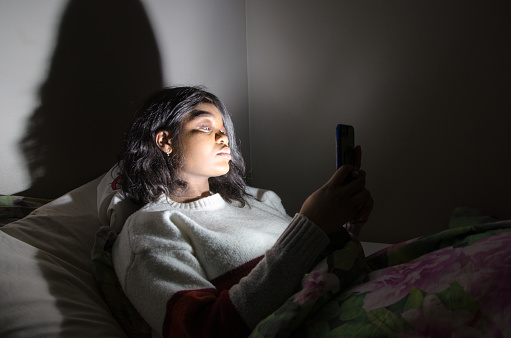
Young person on the phone in the dark. (courtesy photo)
1876 was the year in which the world changed; It was when the first telephone was invented and patented. By 1900, the telephone became very popular. Over the last 146 years, communication has continuously evolved in astounding ways. So much so that people now can’t let go of their phones.
These days, I have noticed that many people prefer to use different social media platforms to communicate instead of calling someone. It is becoming more common, especially among the younger generation.
Before there was social media, people asked for each other’s telephone numbers to keep in touch. However, in today’s world things are quite different. Whenever a friend wants to contact me, the first thing they ask is, “What is your Instagram?” I do not have instagram, so I give them my phone number instead.
My parents don’t allow me to have social media because they feel that it is a distraction that allows too much unsupervised, unchecked communication among youth and young adults. In the past, friends could call each other. Because the phone was in a kitchen, someone else in the household would always be aware of who a young person was speaking to and probably the subject matter.
In these perilous times, it is nearly impossible to supervise texts unless a parent goes all out with special monitoring apps. I know one person whose texts are copied to her dad’s cell phone. My mom thinks that is a little too intrusive so she instead limits my time with my devices. Every parent is different.
Social media communication can be dangerous in many ways. Many people become victims to cyberbullying, which can lead to low self esteem, envy, suicide, and much more. According to DataProt, 59 percent of teenagers in the United States have experienced cyberbullying in 2018. Being on social media often causes a lack of face-to-face interaction. This hinders people from developing socialization skills. Being on social media can also become an addiction, which is a serious issue among teens and young adults, because it distracts them and induces sleep deprivation. One in five teenagers spend five hours or more on social media per day and lose sleep over it, based on a report from NPR Health News.
Social media also plays a part in drug abuse. People sell drugs online through social media, which is illegal. When people buy these drugs they can overdose. The Food and Drug Administration says that opioid consumers put their health at risk when they buy drugs from online pharmacies; the products are marketed as authentic, but often are counterfeit, contaminated, and unsafe.
Don’t get me wrong. Social media can be a source of entertainment, a place to watch humorous videos, share opinions and more, but there are many negative effects that the younger generations are blindly suffering, especially depression. It is important to stay mindful of social media dangers and how much time one spends on it.
Not having social media isn’t stopping me from living life as best as I can. Instead of scrolling through Instagram or TikTok, I watch Netflix, play video games with friends, and talk to them on the phone. Apart from screen activities, I hang out with family and friends. I don’t think that not having social media has affected my life at all, I don’t think it’s worth all of what people say it to be, and it’s definitely not worth all the risks that come with it.
 The Watoto Speak!