Nationbuilding, as defined by Nana Kwame Agyei Akoto and Nana Akua Nson Akoto, is “the process of establishing a defined, independent and ordered spiritual, physical, psychological, territorial and cultural reality.” (Akoto, Akoto, 2021). Every nation must have a clear strategy to facilitate and maintain sovereignty of spirit, mind, body and physical space i.e land. But in order to nationbuild we must be clear on what a nation is.
A nation is a group of people with a shared history, culture, traditions, language, beliefs and values. Each and every generation of Afrikan people is responsible for one specific question; What is the youth’s role in nationbuilding? This is a question that is and will continue to determine how Afrikan people will persist with the development and progression of their nation. It is a very important question that must be revisited by every generation, in order to identify the changes that Afrikan people need to make within their own families and communities to maintain an organized and smooth development of their traditions and cultures.
In Frantz Fanon’s “The Wretched of the Earth” he clearly explains the responsibility of each generation to realize, understand and move forward with their mission in life.
“Each generation must discover its mission, fulfill it or betray it, in relative opacity…Now that we are in the heat of combat, we must shed the habit of decrying the efforts of our forefathers or feigning incomprehension at their silence or passiveness. They fought as best they could with the weapons they possessed at the time, and if their struggle did not reverberate throughout the international arena, the reason should be attributed not so much to lack of heroism but to a fundamentally different international situation.”
(Frantz Fanon, pg.145, 1963)
While critiquing past generations for the shortcomings of their success can be the first step toward understanding what needs to be done next, it is easy for people to lose themselves in the deficiencies of someone else’s mission, and forget to be accountable and fulfill their own. Therefore, the role of today’s Afrikan youth in nationbuilding is to identify familial wounds as well as their own unique gifts and talents. Finding their passions and healing familial wounds will motivate the youth to express and utilize their gifts towards the total independence of Afrikan people. Incorporating the importance of mental health specific to Afrikan people and their experiences, i.e. spirituality, family connections, history, etc., will help to mend the many generational wounds caused by centuries of trauma and the ongoing effects of the Maafa; the Afrikan Holocaust.
The younger generations of today, which consists of Millennials and Gen-z, are immersed in an environment that promotes psychological health as a mandatory factor of mental stability, while also encouraging the separation of the individual from the family unit. The work of the Afrikan youth is to identify their strategy, using their environment to bring balance and identify their contribution to nationbuilding. The esteemed ancestors below are three examples of the youth reacting in a productive way with the goal of benefitting their people, and improving their environment and themselves.
Freedom fighters Ida B. Wells, Josephine Baker, and James Baldwin have proven to be very important activists for Afrikan people, human rights, and self-expression alike. All of these people at some point in their lives left America in order to get a perspective of what freedom really meant for themselves and for their people. During the late 1800s to mid-20th century, America was profoundly rooted in racism, sexism, and limited self expression for all people. There was a certain order that was to be followed within every segregated group, whether it was based on race, religion, or gender/sex, which definitely caused the progressive erosion of creativity.
Ida B. Wells

Ida B. Wells-Barnett was born into slavery on July 16, 1862, in Holly Springs, Mississippi, U.S. She was the eldest daughter of James and Lizzie Wells. During reconstruction, her parents were active participants of the Republican party, and her father was also a part of the Freedman’s Aid Society and helped start Rust College. Since her father had also sat on the board of trustees at Rust College, she attended at a young age, starting her early education. Unfortunately, having to deal and cope with the sudden death of both parents, due to Yellow fever, she was forced to drop out of school and became the caregiver and provider of her six brothers and sisters at the age of 16. She did this by convincing an administrator to hire her for a teaching job at a nearby school. At the age of 20 she and her sisters moved to Memphis, Tennessee to live with their aunt, where she also finished her education at Fisk university.
However, when traveling from Memphis to Nashville after purchasing a first-class train ticket, the train crew told her that she had to move to the section for black people. This had sparked anger in Nana Ida B. Wells, and she refused with a passion, which led her to being forcefully removed from the train altogether. However, she didn’t go out without a fight. During the altercation Nana Ida bit one of the crew members. Knowing her rights she immediately hired a lawyer after returning to Memphis, sued the Ohio Railroad Company, and won $500. Later, the case was taken to the supreme court and the decision was overturned, forcing her to repay the $500. This mistreatment is what sparked her inspiration to fight against the injustices pushed upon her people. By using the alias “lola”, Ida B. Wells wrote and published editorials and articles in Black newspapers that opposed Jim Crow in the south. Finding her voice and passion for expressing her opinions on political matters, she owned two newspapers: The Memphis Free Speech and Headlight and Free Speech, which were used to further the cause of Afrikan American civil rights.
Ida B wells later went on to become “one of the nation’s most vocal anti-lynching activists,” and conducted her own investigation of the lynching, and found that the Afrikan victims of lynch had gone against white authority or had threatened them by either prospering in their business or challenging their politics. In 1892, she published a pamphlet, “Southern Horrors,” that shared her research. Because of her willingness to speak out against racism, her life became more at risk by the day, with death threats and the destruction of the offices of Free Speech. Therefore, in order for her to continue with her work. Nana Ida B. Wells moved to England, and founded the British Anti-Lynching Society in 1894. Wanting to return to America, she moved to Chicago, Illinois and started several civil rights organizations, including the National Association of Colored Women, and married Ferdinand Barnett, having four children together. Although Ida B. Wells was also considered a founding member of the National Association for the Advancement of Colored People (NAACP); she left the organization because “she felt that in its infancy it lacked action-based initiatives.” Ida was also an advocate specifically for Black women’s rights and as the founder of the Alpha Suffrage Club in Chicago, she made sure to lead the 1913 Suffrage Parade in Washington, DC along with dozens of other club members, even when faced with discrimination amongst the Southern white suffragists. Ida B. Wells died on March 25, 1931 in Chicago, of kidney disease.
Ida B. Wells was a powerful woman who allowed her passion to manifest into an important voice of the Afrikan nation. She was alive during three major periods in American history; Slavery, Reconstruction, and Jim Crow. Each transition brought its own level of anguish and adversity that caused the confusion of rights, purpose, and the next determined mission of the Afrikan nation across the globe. Yet through this time of transition Ida B. Wells used her skills and gifts to redirect Afrikan people away from the chaos of extreme societal change back to the original imperative of nationbuilding and the advocacy of human rights. She found the purpose in her struggle and became the light that directed her people in the right direction.
Josephine Baker
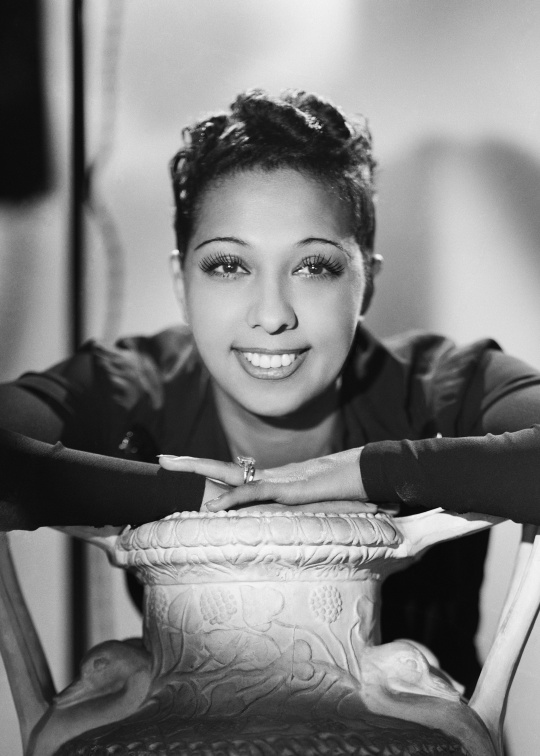
Freda Josephine McDonald, also known as Josephine Baker, was born on June 3, 1906, in St. Louis, Missouri. Her parents, Carrie McDonald and Eddie Carson, who were both entertainers, exposed her to show business at an early age. After being abandoned by her father, in her early childhood, Josephine needed to acquire various jobs to make ends meet, which led her to dance/perform on the streets, and collect money from spectators. Her new found love for performing inspired her to run off with an Afrikan American theater troupe to perform at the age of 15. She married and divorced Willie Baker in 1921, whose last name she kept as her stage name, and over a short period of time Josephine Baker became a well known dancer and performed in several Vaudeville shows during the early 20th century.
After going solo she moved to New York to take part in the Harlem Renaissance, and tried out for many of the girl groups. She was usually rejected for being “too skinny and too dark”, but this didn’t stop her from learning the routine and out-shining everyone in the choreography. This is also where she implemented her comedic act, and due to her outstanding performance, all of the shows she was dancing in were sold out. Wanting more for her career and societal status as a Black woman, she decided to move to Paris, France, where her career flourished. She had more freedom to do what she wanted in the integrated world of Europe. Josephine became one of the most wanted performers due to her distinct dancing style and unique costumes, and a talented actress having starred in films during the 1930s.
From this success she was able to move her family from St. Louis to Les Milandes, her estate in Castelnaud-Fayrac, France. In 1936, she tried to star in a movie filmed in the U.S., but unfortunately found that the U.S hated the idea of a Black woman with so much respect and power being represented in America. So they drove her away by criticing her creuly in The New York Times (they called her a “Negro wench”). She didn’t let this negativity get to her, and set off back to Paris to fight against the Germans in World War II fighting alongside France. She was an honorable correspondent for the French Resistance (undercover) and a sub-lieutenant in the Women’s Auxiliary Air Force, and during the 50s and the 60s she visited America and had to confront segregation and racism. She would refuse to perform to segregated audiences, and forced club owners to integrate for her shows.
Still having to fight against racial injustice, Josephine Baker was recognized by the National Association for the Advancement of Colored People (NAACP), and in 1963, she was one of the few women allowed to speak at the March on Washington for Jobs and Freedom. In her later years she still continued to perform but on April 8, 1975, Josephine premiered at the Bobino Theater in Paris, where she performed for the last time. The show was sold out and she received a standing ovation. Days later, Josephine slipped into a coma, and died from a cerebral hemorrhage at 5 a.m. on April 12. Over 20,000 people crowded the streets or Paris to attend the memorial, and The French government honored her with a 21-gun salute, which made Josephine Baker the first American woman buried in France with military honors. Her gravesite is in the Cimetiére de Monaco, Monaco.
Although historians deliberately portray her as nothing more than a sex symbol and an entertainer, Josephine Baker contributed an amazing amount to the world. Josephine Baker was an activist, a ranked officer in the French military, a mother, a pilot, a philanthropist, and much more. Her work exhibits how the Afrikan youth can utilize their unique talents and gifts for the betterment and progression of the nation. Her determination to show that people can literally do anything they set their mind to is beyond inspiring. Like Ida B. Wells, Ms. Josephine was a multi-talented and outspoken person, and she is a great example of someone who has experienced all sorts of perspectives of the world but always stayed true and connected to her purpose, her values as a civil rights activist and to her people. Mrs. Josephine never got lost or defined herself by the eurocentric definition of a Black woman. She was passionate about life, who she was, and her Afrikanity, which she fought for everyday of her life. As unbearable as American society was to her, she always came back to defend and represent a bright light of hope for her community.
James Baldwin

James Arthur Baldwin was born August 2, 1924, in New York City, New York. He grew up in an impoverished neighborhood as the eldest of nine siblings. After graduating from high school and craving an environment that would allow him to express his thoughts of the world through writing and to gain a broader perspective of his mission as it pertained to the progression and growth of Afrikan people, he moved to Paris in 1948. After he had written his first two novels, – one of which was Go Tell It on the Mountain – and a collection of essays, Notes of a Native Son (1955), he moved back to the U.S. to share his thoughts on the his disappointment of the so called free country, that thrives on the mistreatment and injustice of Afrikan American people. He continued to write books and collections of essays that explored the relationship between Black people and America, which opened the eyes of millions of people around the world to the brutality, and inequalities that were experienced by every person of Afrikan descent in America. James Baldwin also wrote various plays that spoke volumes on the Black experience in America, such as “Blues for Mister Charlie” (debuted on broadway in 1964), which was based on the racially motivated murder of Emmett Till, and in the same year he wrote a book called “Nothing Personal”, that talks about the murder of a civil rights movement leader Medgar Evers. In his later years he grow tired of seeing his fellow civil rights activist getting assassinated, such as Medgar Evers, Malcolm X and Martin Luther King Jr., due to racial discrimination, and ended up changing his diplomatic tone of speaking to a more strident and blatant tone. Near the end of his life he taught at the University of Massachusetts at Amherst and Hampshire College, until his death on December 1, 1987, in Saint-Paul, France.
James Baldwin was a social observer who analyzed and described the Black experience in America. Being an eloquent writer allowed him to express his disappointments with America’s inability to become this so-called “free world.” He did everything in his power to expose the misleading advertisement that was hiding the atrocities and the constant violation of his people behind a wall of lies and self delusion. By using psychological perspective and the recollection of his people’s, including his own, experiences in America, he had the tools to completely unveil the root of the problem and the reasoning for it. He lived during a period in American history that was notorious for deviously silencing Black voices for advocating for themselves and basic human rights, in an attempt to confuse and manipulate the Black community. However, James Baldwin used his skills to shine a luminous light upon the hypocrisy of America, and did by writing a considerably large amount of Novels, short story collections, plays, and non-fictional books.
These are only three out of millions of Afrikan people who demonstrated how Afrikan youth can and should use their unique gifts to facilitate the total independence of Afrikan people. They overcame a system whose ultimate goal was to separate and diminish the importance of their mission by dehumanizing, using psychological warfare, and menticide. These same tactics have unfortunately indoctrinated the majority of the black community in an attempt to opaque the clear path toward nation building.
Nana Agyei and Nana Akua Akoto are two people who fought for a clear mission and the key step to effectively nationbuild. Safe spaces are necessary for the Afrikan youth to identify their passions and learn how to use them effectively in relation to nationbuilding.
“Africa’s children at home and in the diaspora are the descendants of prisoners of war taken in battle for Africa’s human and material or natural wealth, to be exploited by the non-African for exclusive benefit of the non-African. This war is real and perpetual. The battlefronts are the psychic and the physical.”
(Akoto, Akoto, pg. 218, 1999)
Afrikan people around the world have gone through generations of fighting for their freedom and unity as a people. They have been systematically attacked and violated to keep them from regaining power over themselves, retaliating and rebuilding. This has led Afrikan people to fight extremely hard for a nostalgic cohesion that once was of the utmost importance within the Afrikan worldview, with family as the pinnacle of human connection being a core value. Yet, through the extreme experiences of the Maafa, those core values were tarnished. Uniqueness, self expression and self-care if not careful can morph into Individualism, leading to a narcissistic mindset and behaviors. Where the Afrikan family and community has been a sacred space that promoted connection and growth, it can become an institution of confinement and maladaptive coping mechanisms that develop into obsessive/compulsive behaviors, passed down through generations.
Mental Health

In the 1960s, a psychologist conducted an experiment on how dogs react in stressful environments and the similarities that they have with humans. The dogs were not given a way out of a stressful situation for an extended amount of time, which caused psychological damage and made the dogs unconsciously learn helplessness as a coping mechanism (Seligman et al., 1967). Coping mechanisms are what all humans use to get out of these depressive habits, but even coping can exacerbate this negative situation.
Coping mechanisms are used as strategies to deal with a stressful or traumatic situation that creates painful emotions. They are usually helpful with maintaining emotional and mental stability that should later lead back to recovering a comfortable lifestyle. However, sometimes these coping mechanisms can turn into problematic habits. For example, if someone were to use an emotion-focused coping mechanism such as cycle of grief – a natural coping mechanism that occurs when someone is dealing with an overwhelming amount of grief – that person can get lost in their grief and spiral into an even worse mental state than before.
A helpful solution is the concept of social support. In over 100 studies conducted between the years of 1982 and 2007 scientists concluded “that individuals with stronger social relationships have a 50% greater likelihood of survival compared to those with weak or insufficient social relationships” (Holt-Lunstad et al., 2010, pg. 544). Thus having a support system with people that positively re-enforces, helps to maintain and manage their mental health will lower risks of mortality and chronic illnesses. The reduction of mortality and chronic illness is necessary to help heal the wounds and allow us to stop contributing to our own demise.
Afrikan people are suffering from the post traumatic stress disorder (PTSD) of the separation of their families, communities, and nations. During the Maafa, Afrikan people have worked hard to redevelop that same safe space for cultural and mental growth. However, they have a disadvantage, because of the notorious brutality and mistreatment that they have faced specifically, regarding nationbuilding. This has led Afrikan people to unintentionally disregard their complete health; mental, spiritual, and physical. This is a defense mechanism that is supposed to protect and block out any external negativity from adulterating and confusing them from within.
“…it should now be clear that the Maafa was as much a psychological-spiritual experience as it was a physical one…These psychical upheavals in the lives of the enslaved Africans must have a forged irreparable psychical damage to the African’s sense of cultural sovereignty and their sense of the sanctity of their very humanity.”
(Kobi K. K. Kambon, pg. 103, 1998)
One of the coping mechanisms the Afrikans adopted is the fight or flight reflex which is caused by fear. The wounds of ptsd are the fight or flight response to the loss of families or the want to integrate into society. “Black people throughout the world, live under the power of the white supremacy system of total oppression and domination, implying the absence of any true power to determine ultimately what happens to their individual and collective lives.” (Wesling, pg. 154, 1991) According to Kobi K.K. Kambon’s “African/Black psychology in the American Context: An African-Centered Approach,” the generational trauma gained by the affects of Maafa has “created a critical spiritual void and left behind a profound distortion in the (collective-cultural) psychological existence/identity of Africans.”(pg 105)
With the knowledge of these elders, who are two important pioneers of Afrikan centered psychological analysis, the role of Afrikan youth in nationbuilding is to heal the wounds of the profound and overwhelming trauma that has been inflicted upon the Black nation and is still in effect today. Afrikan people must reestablish and redefine sovereignty, the blessings and the responsibilities freedom comes with. The youth are the new minds full of imagination, thoughts, emotions and spirit, imbued with the wisdom of our elders, in order to heal the wounds of our people. Afrikan youth will ultimately find solace and inspiration in the principles and guidance of family and community, building upon a solid foundation with a clear mission to facilitate Afrikan nation building and reafrikanization.
Every nation has a mission to help retain cultural practices and history to pass down to the next generations. My paternal grandparents Jacques and Therese Allrich were Haitian immigrants that migrated to America with the hopes of living and creating the “American Dream” proposed to them by popular media, as a better alternative to the living conditions in Haiti. They put faith in this dream in order to build a safe and opportunity filled environment for their new family. Coming to America as Haitian immigrants during the 1970s was definitely a difficult transition, having to deal with a shift in culture that totally combatted everything that they stood for. They came with a mission to start and raise a large family in a healthy and productive environment, with the values of family cohesion, community development, and education, deeply rooted in their core religious principles.
My maternal grandparents, Kwame Agyei Akoto and Akua Nson Akoto are descendants of community builders and educators who moved their families from Mississippi to Miami Florida during the great migration of the 1950s. They came to Howard University seeking the knowledge and strategies to build their family, and augment their skills for the betterment and growth of the Afrikan nation. After starting their family, they soon realized the need for an education that promoted authentic and Afrocentric knowledge, which led them to found NationHouse Positive Action Center, with their colleagues Akili Ron Anderson and Kehembe V. Eichelberger. Later these four audacious visionary founders, with the help of many other Pan-Afrikanist (10 women, 21men), established the Ankobea Obusua Society. My grandparents’ commitment to family and the persistent development of Afrikan people have opened doors for their children, grandchildren, great-grandchildren, and etc. to have access to an unlimited knowledge of self, spirit, and community.
Afrikan youth must learn from the lessons of their lineages. They must learn how to use the traditions and values of their families, and add their own perspectives and goals in life to better express themselves with the foundation of their family principles. Being able to be an extension of their family means that they will have to extend their familial beliefs. Obtaining and applying the principles of family, education, spirit, and psychology that I have learned from attending Nationhouse, has helped to shape my perspective of the world and the mission that I must accomplish in order to utilize my skills and talents for the advancement of my people.
Stepping into the next stage of my life, I will attend college with the intention of becoming a neurosurgeon that heals both the physical and psychological mind. I will use my skills to heal and restore the minds of Afrikan people in the path toward nationbuilding and reAfrikanization, a path that I continue in the footsteps of my parents and forebears.
That being said, I would like to thank my amazing parents, Mama Akua and Baba Asukile, for raising me in an environment that quenched my thirst for knowledge and that shaped me into the intelligent, and confident Afrikan woman that I am today. For loving me unconditionally and supporting me everyday of my life. I would like to thank nanny, popop, grandma, and papi for raising my parents into the wonderful people that they are, and for their determination and missions that have given me the opportunity to stand here today. I would like to thank my brother, Agyei, Nia, and Mandi for making me laugh when times were hard and forcing me to enjoy the good times.
And last but certainly not least I would like to thank the most brilliant, diligent, and ambitious women that I will probably ever have the pleasure of knowing; Auntie Tewa, Auntie Mavhu, and my wonderful mother. These three women have been my teachers since day one. There are no words that can describe the love and admiration that I have for these women. These past three years haven’t been the easiest, but through all of the pain and hardships that have been endured, these three women never stopped fighting for the continuation of education and family development that was extremely necessary during this time. I would not be here without them and I will not leave without giving them the recognition and credit they deserve. I will always carry with me the lesson that I have learned from Nationhouse, my family, and my friends, into every transition of my life. I will never forget who I am and what I must do to lead the next generations of Afrikan youth to freedom.
Works Cited
Welsing, Frances. “Black Fear and the Failure of Black Analytical (ideological) Commitment (June 1979).” The Isis Papers: The Key To The Colors, pp. 154, Third World Press, December 1, 2004, Chicago, IL 60619.
Kambon, Kobi. “The Maafa: The African Holocaust in the Americas and African/Black Psychology.” African/Black Psychology in the American Context: An African-Centered Approach, pp. 103, Nubian Nation Publications, 1998, Tallahassee, FL.
Akoto, Kwame Agyei, and Akua Nson Akoto. “Abbreviated Glossary.” The Sankofa Movement: ReAfricanization and the reality of war, Oyoko InfoCom Inc., 2021, Washington, DC
National Park Service. “Ida B. Wells.” US National Park Service, National Park Service, December 30, 2020, www.nps.gov/people/idabwells.htm.
Steptoe, Tyina. “Ida Wells-Barnett (1862-1931).” BlackPast.org, BlackPast, January 19j, 2007, http://www.blackpast.org/african-american-history/barnett-ida-wells-1862-1931/.
Britannica, The Editors of Encyclopaedia. “Ida B. Wells-Barnett”. Encyclopedia Britannica, 21 Mar. 2022, http://www.britannica.com/biography/Ida-B-Wells-Barnett. Accessed 26 May 2022.
The Official Site of Josephine Baker. “Josephine Baker.” About Josephine Baker, CMG Worldwide, http://www.cmgww.com/stars/baker/.
Arlisha R. Norwood, NWHM Fellow “Josephine Baker.” National Women’s History Museum, National Women’s History Museum, 2017. www.womenshistory.org/education-resources/biographies/josephine-baker
Biography.com Editors. “James Baldwin Biography.” The Biography.com website, A&E Television Networks, April 2, 2014, www.biography.com/writer/james-baldwin.
Britannica, The Editors of Encyclopaedia. “James Baldwin”. Encyclopedia Britannica, 27 Nov. 2021, https://www.britannica.com/biography/James-Baldwin. Accessed 26 May 2022. Poetry Foundation. “James Baldwin.” PoetryFoundation.org, Poetry Foundation, 2022, http://www.poetryfoundation.org/poets/james-baldwin.
 The Watoto Speak!