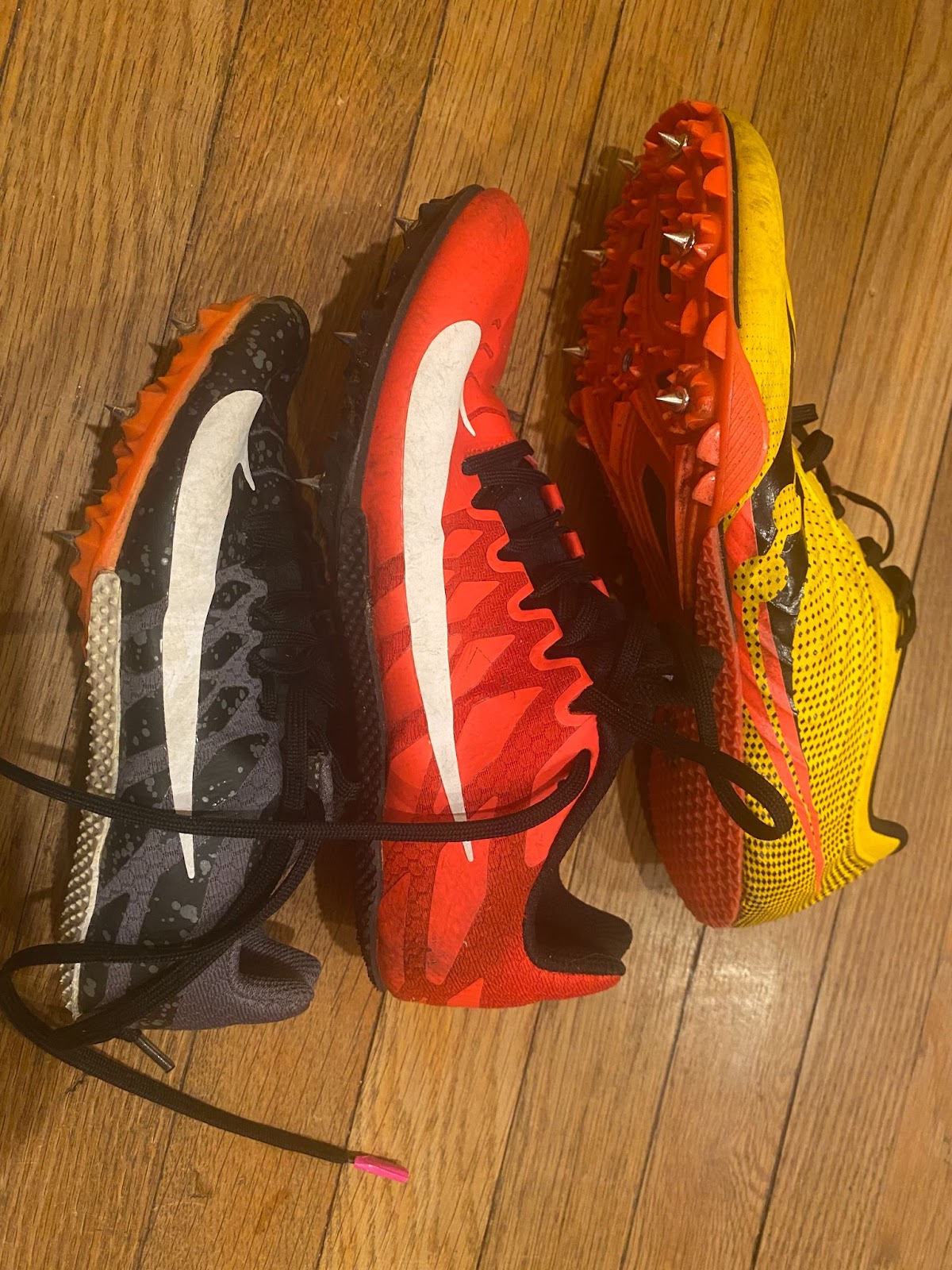
The 400-meter dash is a track and field event that is usually run as one lap around an outdoor track. In an indoor track, which is 200 meters, it is two laps. The start is staggered so everybody runs the same distance. The 400-meter is described as a long sprint but humans can rarely sprint the whole race. This is the challenging part. The 400-meter is just a balance between fast and too fast. One of the greatest challenges I’ve overcome was preparing for the outdoor 400-meter. To make this happen, I trained with my coaches, watched videos of other athletes running the 400-meter, and journaled about the 400-meter.
My coaches motivated me to work harder at practice. One of the exercises they had me do was run long distances more often, like ten 300-meters. Running a lot of 300-meters improved my endurance, so I could run fast for longer. My coaches had me run up and down the hills behind the track. It is helpful to run up hills because this commands your body to bring your knees up higher due to the incline. If this philosophy worked I would have longer strides toward the end of the race. The last exercise my coaches had me do was to improve how I start my race. They did this by telling me to put my leg closer to my knee while in the “on your mark” position. My start training was important because if you have a good start you can be ahead without using too much energy. This training was fun yet grueling. My body was aching but I knew I was improving my 400-meter time.
The videos I watched gave me information about the 400-meter. I learned that in the beginning, you should sprint so you can use your reserve of “free energy” before the lactic acid kicks in. I also learned that in the second 100 meters of the race, you should pace yourself so you don’t burn yourself out in the concluding 200 meters. The final 200-meter is just a sprint. The winner will normally be the person who has the most remaining energy at the halfway point of the race. This is where the sprint can be broken open because the people with more endurance pull ahead.
The last action was to improve my 400-meter time by taking notes on the videos that I watched. Taking notes is a simple activity that can make you better at your activity. Writing helps you remember information. I have a mini journal that has all my notes from the videos I have watched. The bulk of my notes was about the sprinters’ starts. I noticed their arms were swinging super fast and strong. One video also told me to breathe through my mouth. The information includes a drawing of the strategy for the 400-meter. I reviewed all my notes the day before the meeting. This is how I remember all my notes.
At the end of the meet, I got 7th out of 42 and achieved a personal record of 1:07 seconds. In the first 100-meters, I got a good start and I was already up on the guy in lane 4. After the race, I noticed I had listened to the mechanics that my coaches had corrected me on. After this, I paced the second 100m. Toward the halfway point, I thought I had sprinted the whole race because the momentum of the first 100-meters had quickly carried me through the second 100-meters. After the second 100-meters, I made up ground on the people who had run the first half too hard. In the final 100-meters, I ran as fast as I could and crossed over the tape in one minute and seven seconds.
After the race I thought about my training, watching the videos and writing notes. When people are trying to improve an activity that is important to them they should learn and remember. People should know that it takes hard work to get better at their craft.
 The Watoto Speak!