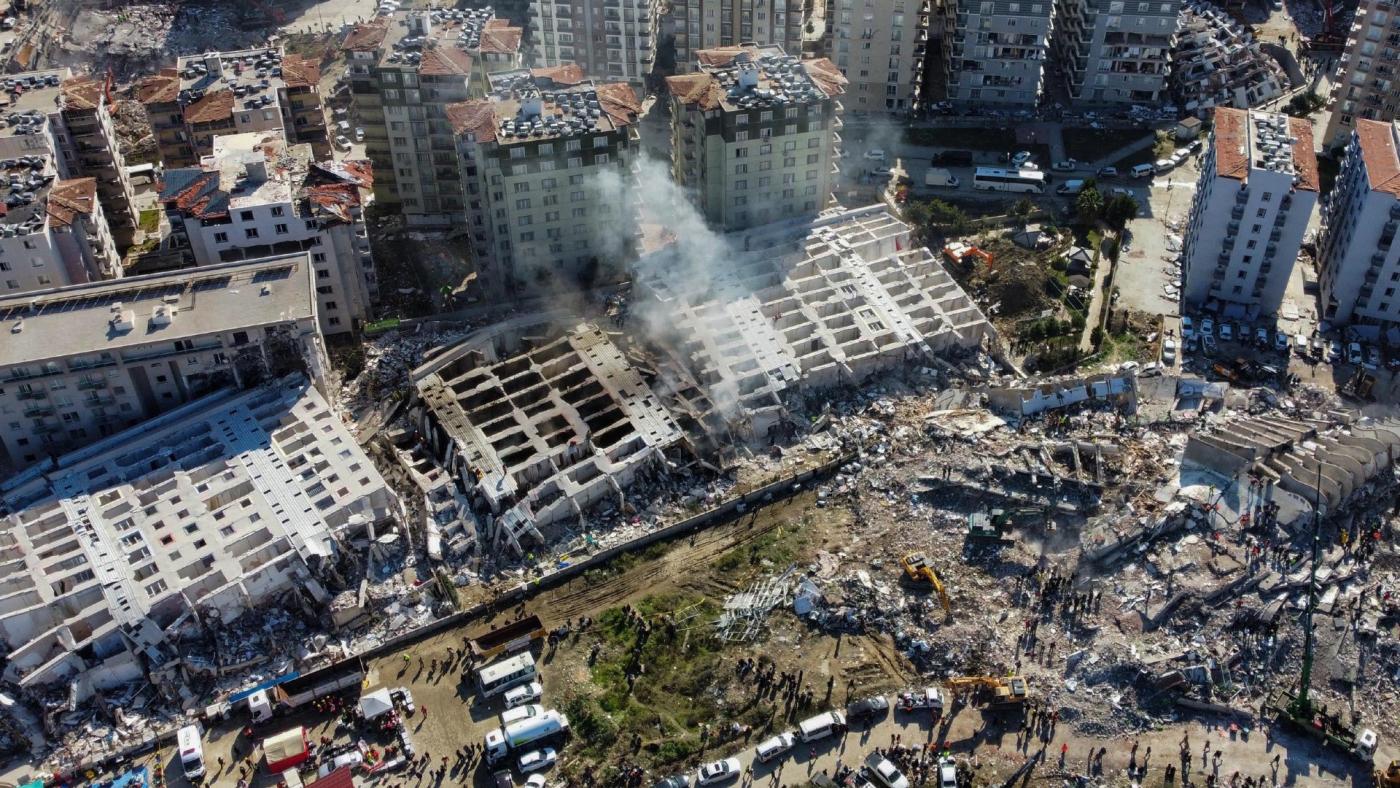
The aftermath of a 7.8 magnitude earthquake in Hatay, Turkey. (Photo courtesy of http://www.middleeasteye.net)
In early February, a devastating 6.3 magnitude earthquake struck areas of Syria and Turkey. It destroyed multiple cities, and left a climbing death toll of 47,000 and many aftershocks.
The recent earthquake shows us that humans, the dominating organism on planet Earth, need to mitigate production of carbon emissions. It is imperative that we invest in Earth-friendly solutions like electric vehicles and solar panels. They can prevent unnecessary increases in sea level and excess damage to the Ozone. They can also help reduce the rate at which the Earth is warming.
Global warming is the root of most natural disasters today. It causes ice caps and glaciers to melt. The rising sea levels trigger seismic activity such as earthquakes, volcanic eruptions, tsunamis, and landslides.
Until there is a sense of urgency in everyone, frightening disasters such as earthquakes will only continue to happen more frequently. Earthquakes take place when tectonic plates located in the Earth’s lithosphere are triggered to shake. The earthquake in Syria and Turkey happened when the Arabian tectonic plate and the Anatolian plate shifted past each other.
As the climate warms and sea levels rise, more hurricanes and typhoons are likely to form and be more severe. With this excess rainfall, the soil is losing its ability to hold water. Then the water collects over the ground resulting in mudslides and landslides.
Furthermore, the weight on the Earth’s crust lessens which leads to isostatic rebound. This is when the crust bounces back from where the ancient glaciers once sat, lifting magma pressure that feeds volcano chambers, thus causing more seismic activity. Isostatic rebound creates volcanic eruptions, especially from underwater volcanoes. This releases more carbon into the air, leading to a negative cycle of global climate change.
The carbon that our modern world produces from all oil-powered vehicles and factories attacks the Ozone layer. Carbon is a greenhouse gas which traps heat inside the atmosphere. Scientists have discovered that chlorofluorocarbons along with other gasses are responsible for depleting the Ozone layer.
The Ozone layer is located in the stratosphere, right above the troposphere which is the layer in which we live. It protects us from the sun’s harmful radiation. As the giant hole in the Ozone layer continues to grow, ultraviolet rays are able to reach Earth. Consequently, our Earth is warming consistently.
Last November, the 27th United Nations Climate Change Conference or Conference of the Parties of the UNFCCC, more commonly referred to as COP27, was held in Sharm El Sheikh, Egypt. During the conference, world leaders established funding to compensate vulnerable countries for loss and damage that is created by natural disasters fueled by global climate change.
Although we have already done so much irreversible damage to our home, we can slow down global climate change and prevent natural disasters like the earthquake in the Middle East by planting some trees, purchasing solar panels for our homes, and investing in electric vehicles. The government can also help by creating clean energy standards and providing funding for citizens who cannot afford energy efficient materials.
The people in Turkey and Syria will greatly benefit from the new loss and damage funding agreement to help their people recover and rebuild the hundreds of thousands of buildings that have been damaged or destroyed by this catastrophic event. However, until new clean energy guidelines are put in place, more earthquakes like this one will continue to happen.
There are other natural disasters happening around the world as a result of global warming. The excessive flooding and rainfall in California, and an exceptionally great amount of snowfall in the midwest has kept people indoors. Humans are living in a time when turning on a lightswitch or putting a key in the ignition isn’t so simple anymore. That’s why investing in clean energy solutions is imperative.
 The Watoto Speak!