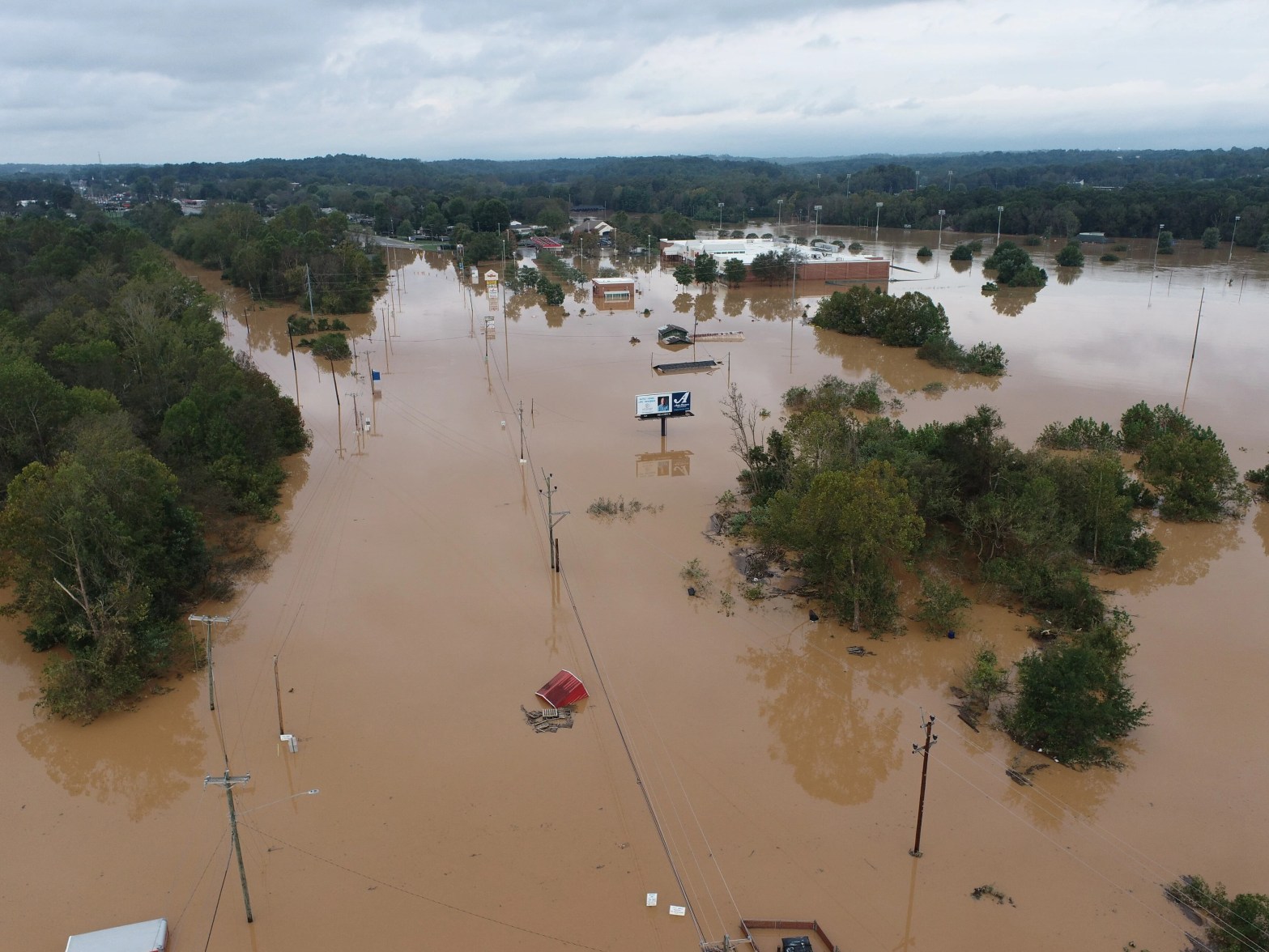
Hurricane Helene left widespread flooding in Georgia on September 26-27 2024. (Photo courtesy of Surfrider.org)
On September 26, 2024, Hurricane Helene, a category 4 hurricane, claimed 230 lives in Florida, Georgia, South Carolina, North Carolina, Tennessee and Virginia. This devastated the Black communities most, making it the deadliest mainland hurricane since Katrina of 2005.
Many of those Black communities are still dealing with the effects of previous hurricanes like Laura, Delta, Harvey, and Idalia because they never received the proper amount of aid from the U.S. government, according to Harvard Kennedy School. The susceptibility of Black communities to hurricanes and other natural disasters is a direct result of a discriminatory practice called redlining.
Redlining allows for banks backed by the Federal Housing Administration to systematically withhold mortgages, insurance loans, and other financial services from Black communities. It coerces the Black population in the U.S. into living on land that will be affected by natural disasters the most.
Redlining worsened how banks and the government regarded Blacks, effectively isolating Black communities in areas that would suffer little to no levels of investment unlike their white counterparts. During the early 20th century close to a third of Chicago neighborhoods were given a “D” grade and marked red on a map thus, “redlined”. These predominantly Black communities were deemed unfit for investment by corporations, and residents within these neighborhoods were oftentimes denied bank loans and insurance, according to the Chicago based newspaper, The South Side Weekly.
On top of this, corporations are not investing in communities of color which means the non-white population doesn’t have easy access to amenities or general merchandise stores. In 2021, The Aspen Institute found that the current racial wealth gap is a result of generations of overtly racist policies. Black families own approx. 23 cents for every $1 of white wealth, and Hispanic families own approx. 19 cents for every $1 of white wealth. According to Federal Reserve data, the racial wealth gap has grown 23% from 2019 to 2022. This is an ever-growing problem that corporations need to fix.
Black families who live in these neighborhoods tend to be of lower income, and this means that many families are required to engage in drug dealing and other illegal activities to make extra money. This leads to more gang violence, and a more run-down neighborhood. The practice of redlining takes advantage of this and pressures Black and other minorities to stay there away from white communities by raising the prices of homes just enough that the average working class minority family cannot afford.
Black and Hispanic communities struggle with air and water pollution, reproductive health disorders, and fewer urban amenities due to the practice of redlining.In 2022, the University of Berkley found that residents living in previously “D” graded neighborhoods lived in proximity to twice the density of oil and gas wells as those in formerly “A” graded neighborhoods. These people living in these historically redlined communities are highly vulnerable to health problems. Berkeley’s studies show that living in redlined areas has been linked to severe asthma, birth outcomes, cancer stage at diagnosis, urban heat, and food environments. Many of these health conditions place individuals at very high risk of having detrimental effects from Covid-19, RSV, or pneumonia. Berkley also says that people of color are disproportionately exposed to greater levels of air pollution, and this is how redlining controls the minority.
Over time, generations of Black and non-whites have simply lived in the same place without knowledge that it is less safe than white communities not only because of crime, but because of natural disasters and the effects of living in historically redlined communities.
Despite being banned in the Fair Housing Act of 1968, redlining still thrives. The Department has expanded monitoring of bank institutions that conduct the majority of mortgage lending for potential redlining. They have resolved 14 instances of redlining according to their Office of Public Affairs. Communities of color that have experienced discrimination have received $144million in relief has been spread across their impacted communities.
A complaint filed to the Justice Department alleged that from 2017 to 2021, Citadel LLC., an American hedge fund, failed to provide lending services to majority Black and Hispanic neighborhoods in and around Philadelphia. This caused people to be discouraged from seeking credit in those communities from obtaining home loans according to the Justice Department’s Office of Public Affairs.
Furthermore, the complaint states that Citadel branches were basically exclusive to majority white communities as opposed to little to no branches in Philadelphia which contains 75% of the Black and Hispanic population according to the Justice Department’s Office of Public Affairs.
However, under a proposed consent order, Citadel agreed to invest 6.5 million to increase credit opportunities for Black and minority communities.
This is a first step to ending redlining, and allowing for a more equal America.
Redlining affects marginalized communities in a way that contributes to the devastation of natural disasters. This is because redlined communities have less amenities for example less tree cover, less greenspace, air pollution, water pollution, higher temperature, and more.
If you are discriminated against, you cannot let it slide under the rug, and it must be reported to anti-discrimination organizations like the Civil Rights Division, Fair Employment Practices Agency (FEPA), U.S. Equal Employment Opportunity Commision (EEOC).
 The Watoto Speak!